Compact DP ebook

Dynamic Programming in one shot

A short, focused guide for the students who are tired of feeling like DP is magic. Learn the big idea, the exact mental model, and the repeatable recipe that makes new questions stop feeling random.

49499
Launch pricing
Digital ebookBeginner-friendlyGreat for revision

Compact enough to finish quickly. Strong enough to keep helping during revision.
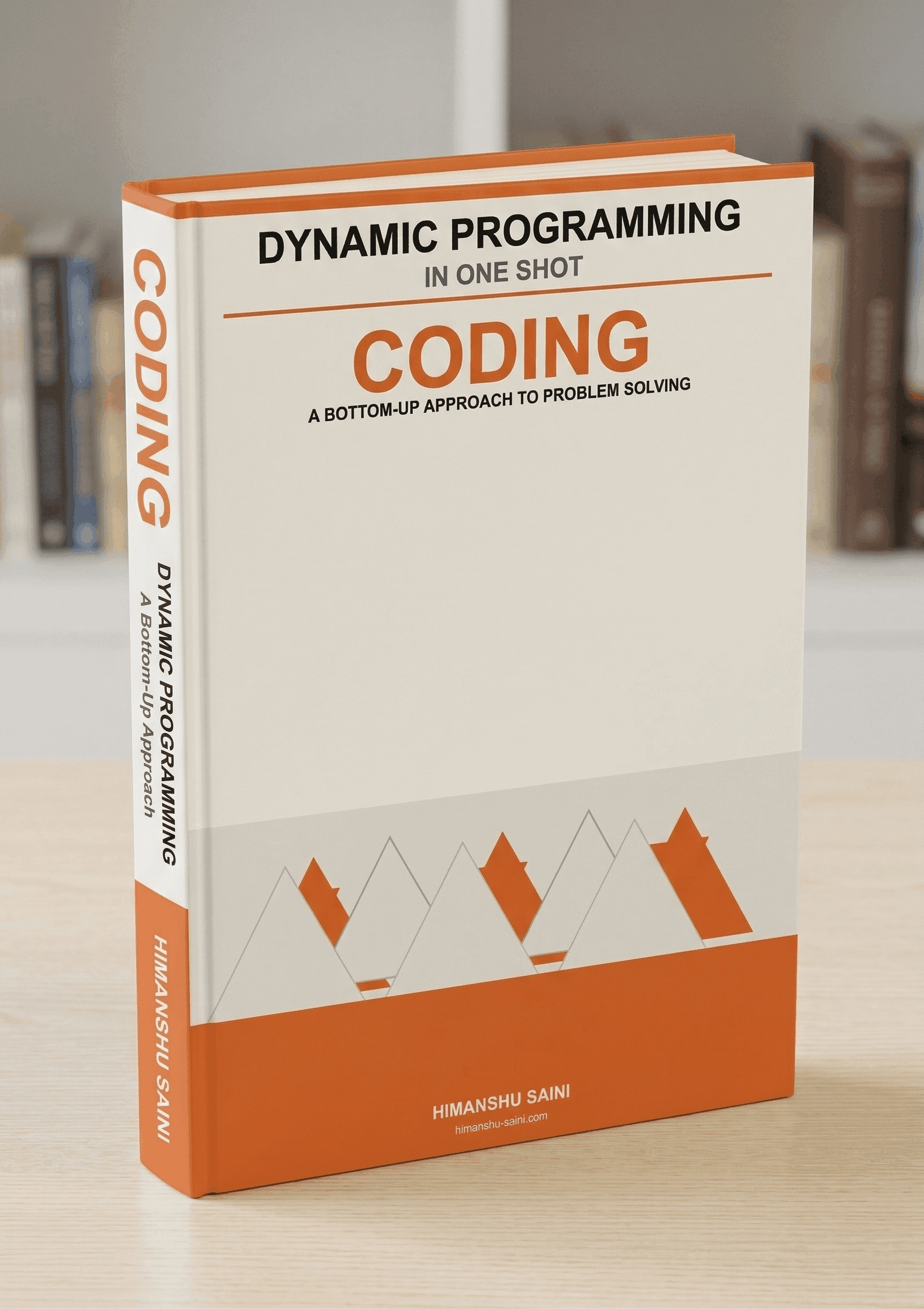
FeaturedDynamic Programming in one shot ebook cover
Why people buy it
  • Pattern-first explanations instead of random solutions.
  • A cleaner mental model for stages, states, and transitions.
  • Short enough to finish, rich enough to reuse during revision.
Table of contents

What's inside

The flow moves from intuition to implementation, then into classic examples and a more advanced outlook on how Dynamic Programming is used.

01

What is Dynamic Programming?

  • The Big Idea
  • A Brief History
  • The Greedy Trap
02

The Core Concepts

  • Stages
  • States
  • Principle of Optimality
03

Memoization vs. Iteration

  • Naive Recursion Problem
  • Memoization
  • Bottom-Up DP
04

The Master Recipe

  • Formulate Recursively
  • Build Bottom-Up
  • Complexity Analysis
05

Classic Beginner Examples

  • Minimum-Delay Commuter
  • Edit Distance
  • Text Segmentation
06

Taking it to the Next Level

  • Discounting Future Returns
  • DP Under Uncertainty
Built for

The students who want DP to finally feel learnable.

  • Students who keep solving DP by pattern-matching without understanding why it works.
  • Placement and internship prep candidates who need a compact revision asset.
  • Anyone who wants the bridge between intuition, recursion, memoization, and iterative DP.
Ready to pick it up?

One strong revision asset is better than ten half-watched tutorials.

If DP keeps eating your time, this is the shortcut: one polished ebook, one clean mental model, one price that makes it easy to start today.

49499
Get Dynamic Programming in one shot
FAQ

Before you buy

Who is this ebook for?

It is for students preparing for placements, internships, and LeetCode rounds who want Dynamic Programming to feel structured instead of random.

Is this only for beginners?

It starts from the big idea and core concepts, but it also moves into uncertainty, discounting future returns, and a stronger DP decision process.

What makes it different from a random DP sheet?

The focus is on building mental models, not dumping questions. You learn why DP works, how to choose states, and how to turn that into a repeatable recipe.